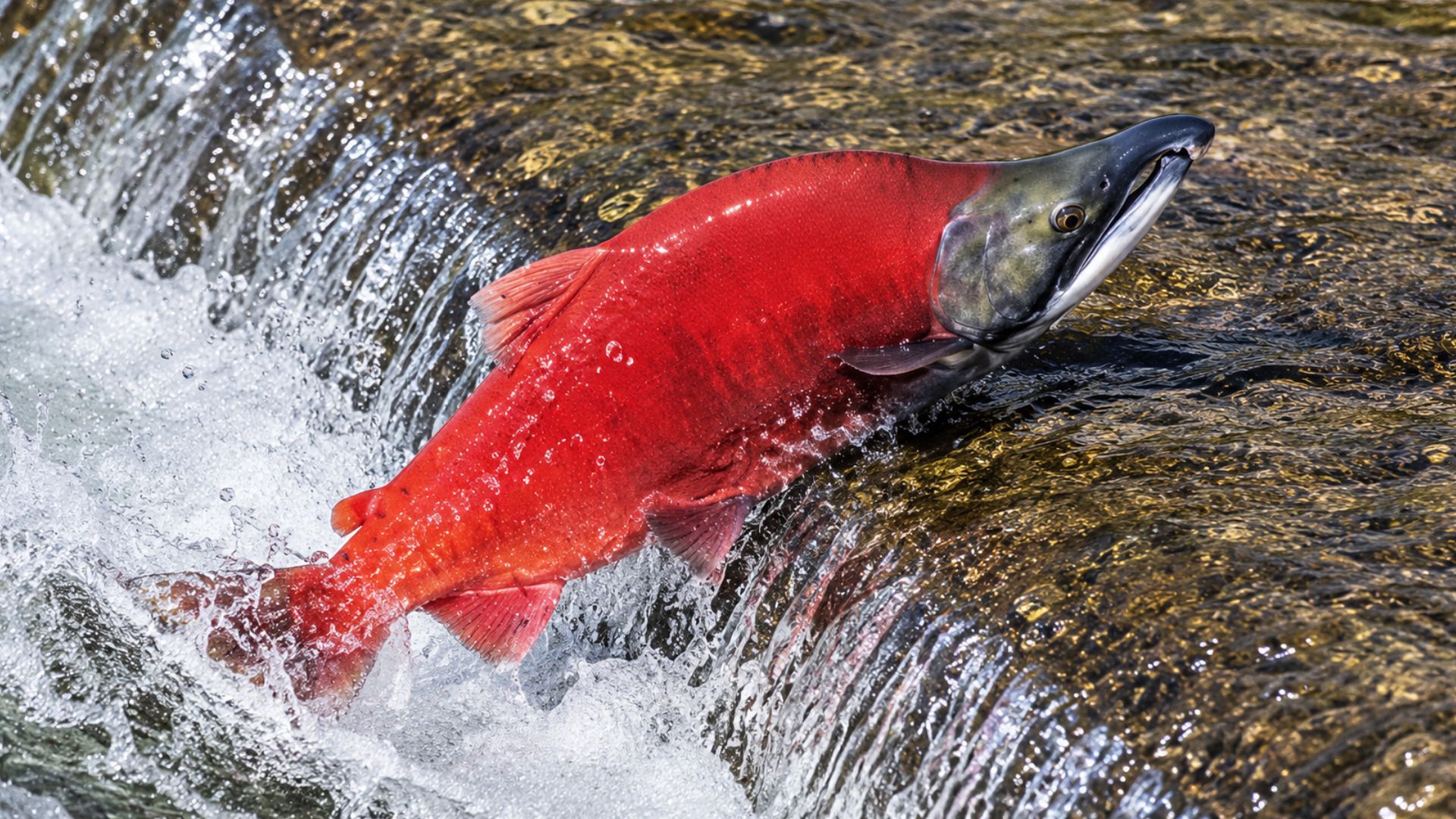
#6: Salmon – Geomagnetic Information
Salmon are famous for returning toward the rivers associated with their early lives, but smell alone cannot explain every stage of a journey that may begin far out at sea. Research indicates that salmon can use Earth’s magnetic field as part of their long-distance orientation system. Magnetic conditions vary predictably across geographic space, potentially providing fish with information analogous to a large-scale natural map. Experiments with juvenile salmon have demonstrated directional responses when researchers expose them to magnetic fields simulating locations at different points within their oceanic range. Large-scale studies have also found relationships between geomagnetic conditions and the routes returning salmon use around geographic obstacles. Once fish approach their natal rivers, olfactory cues become especially important for locating the correct watershed and spawning areas. Navigation therefore appears to involve multiple sensory systems operating at different scales rather than one miraculous internal compass performing the entire journey. Exactly how salmon detect geomagnetic information remains under investigation, as it does for many magnetically sensitive animals.