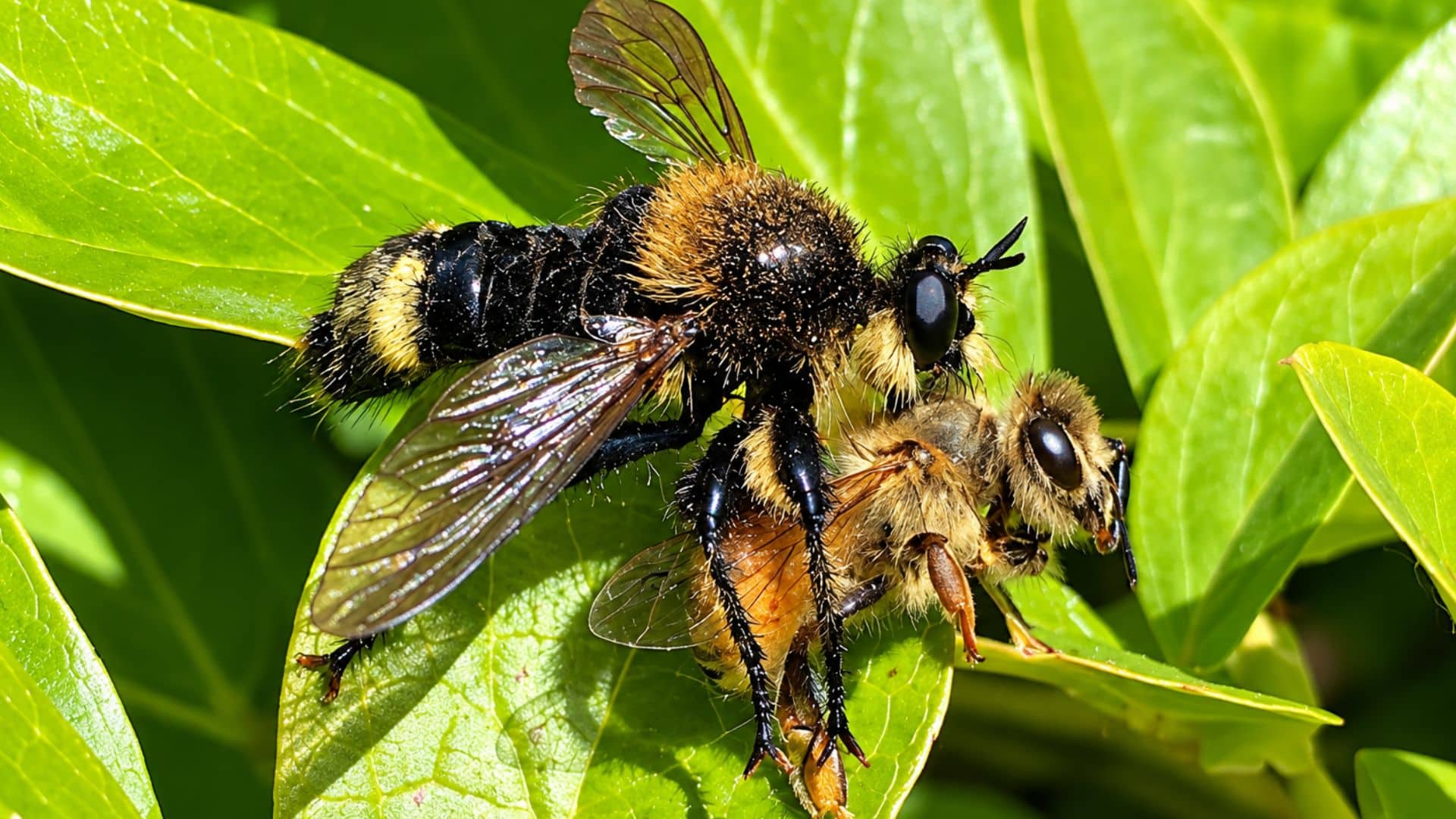
#10: Robber Flies – Mimicking Bumblebees and Wasps
Robber flies complicate the idea of harmless mimicry because these insects are not harmless to other insects at all. They are formidable aerial predators that capture prey with strong legs and pierce it using specialized mouthparts. Humans, however, do not face the kind of venomous sting suggested by the appearance of many bee- and wasp-mimicking species. Some robber flies in groups such as Laphria are densely hairy and colored in black, yellow, or orange, making them resemble bumblebees. Others have slimmer bodies that create a more wasp-like appearance. The disguise may reduce attacks from vertebrate predators that avoid stinging insects, even though the robber fly’s actual offensive equipment evolved primarily for hunting prey rather than defending itself like a bee. This makes the evolutionary story more interesting than a simple defenseless animal wearing a dangerous costume. A robber fly is genuinely dangerous if you happen to be another insect; it simply advertises a different kind of danger from the one it actually possesses. Its resemblance can be remarkably effective while it sits on vegetation waiting to launch an ambush.