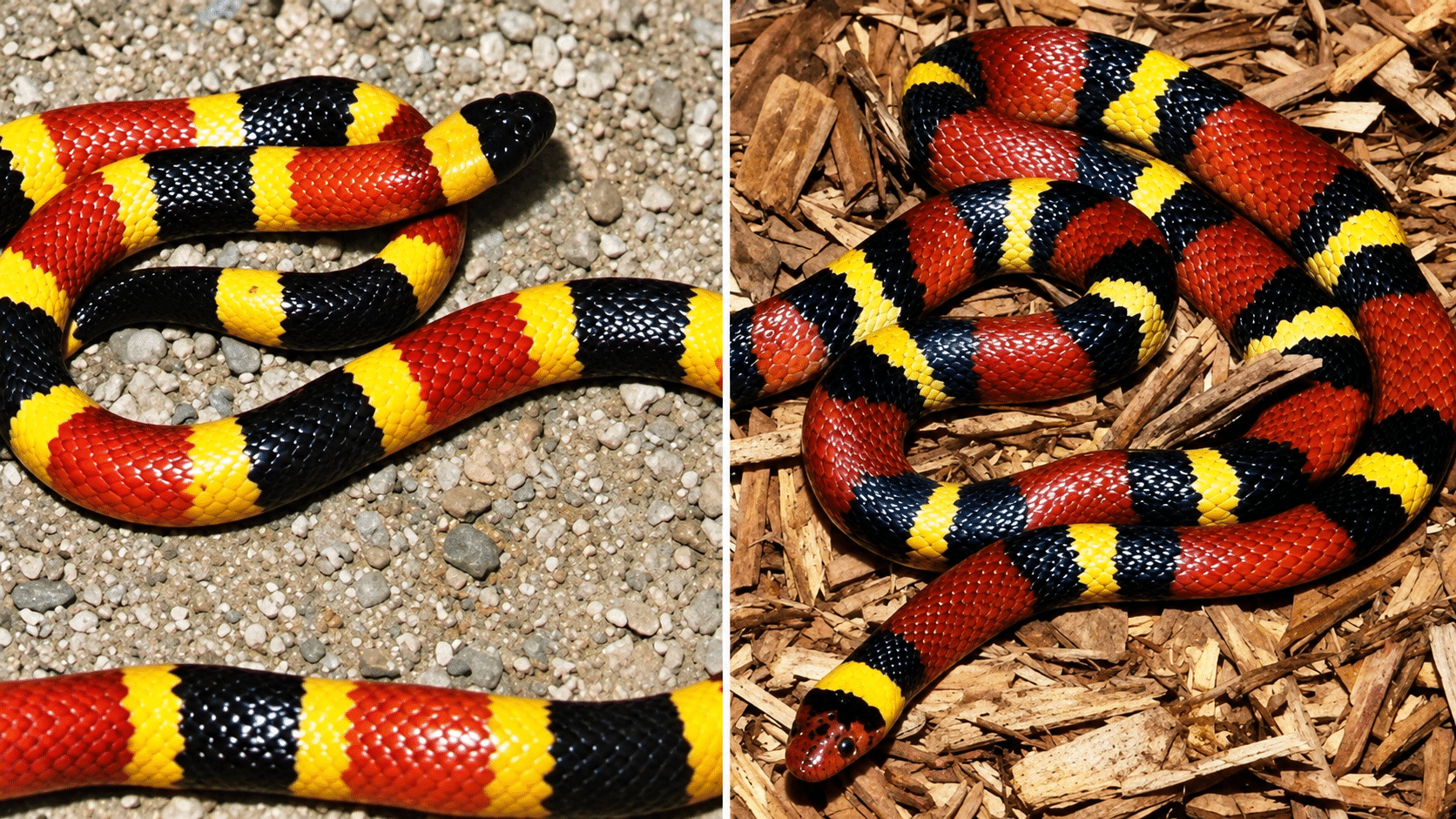
#3: False Coral Snakes – Mimicking Venomous Coral Snakes (Too)
The name “false coral snake” is applied to several nonvenomous or comparatively harmless snakes whose coloration resembles that of true coral snakes. Across Central and South America in particular, different species display combinations of red, black, yellow, white, or orange bands capable of producing remarkably convincing visual imitations. This creates what researchers sometimes describe as mimicry complexes, where multiple dangerous and harmless species share broadly similar warning patterns within the same ecological community. Predators do not necessarily need to distinguish every participant in that system. If enough genuinely dangerous coral snakes make attacking the pattern risky, harmless look-alikes can gain protection simply by resembling the general warning signal. Some false coral snakes reinforce the impression through defensive behavior, hiding the head, coiling, or presenting conspicuous portions of the body when threatened. The imitation is rarely perfect when examined carefully, but predators often make decisions under poor lighting, partial visibility, and considerable time pressure. Evolution does not require a counterfeit to fool a taxonomist. It only needs to delay an attack.