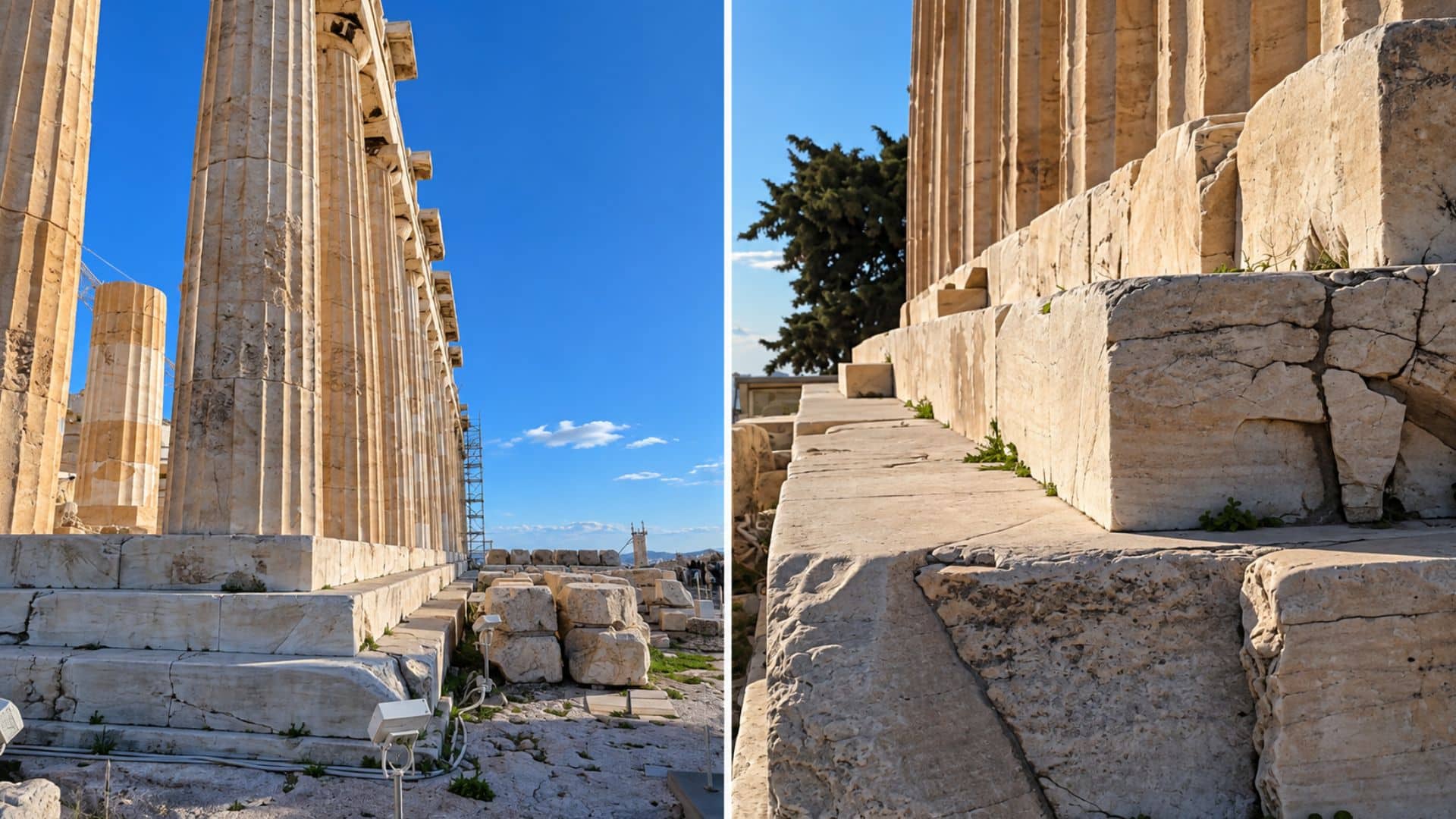
Perfect symmetry looks impressive on paper, but some remarkable buildings and landscapes become more interesting precisely where the pattern breaks. Architects have curved surfaces that appear straight, shifted rooms away from obvious axes, arranged stones unevenly, and allowed natural materials to resist geometric uniformity. Sometimes these choices solve practical problems; elsewhere they manipulate perspective, respond to difficult terrain, express philosophical ideas, or deliberately keep a composition from feeling static. A few irregularities are so subtle that thousands of visitors can stand beside them without realizing anything unusual is happening. Others define the entire experience of moving through the site. Keep reading and look a little closer, because the details that initially seem misplaced, uneven, or unfinished often reveal just how carefully these landmarks were designed.
#1: The Parthenon – Athens, Greece – Curved Stylobate and Column Entasis
From a distance, the Parthenon appears to embody mathematical straightness, with horizontal platforms and disciplined rows of marble columns forming an almost impossibly controlled rectangle. Look more carefully, however, and the supposedly straight building begins to bend. The stylobate on which the columns stand rises slightly toward the center rather than remaining perfectly level, while the columns themselves use entasis, a subtle swelling of their shafts. Corner columns also differ slightly from their neighbors, and the spacing between columns is not completely uniform throughout the structure. Scholars have debated the precise motivations behind these refinements, including structural, aesthetic, and optical considerations, so it is safer not to reduce them to a single trick for “correcting an optical illusion.” What is clear is that the architects Iktinos and Kallikrates created a building whose apparent regularity depends on carefully controlled departures from simple geometry. A perfectly straight reconstruction would therefore not reproduce what ancient Athenians actually built in the fifth century BCE.